



Overview
Introduction
Passwork supports a fault-tolerant architecture that provides high availability and keeps the service running even if individual infrastructure components fail.
Fault tolerance allows you to:
- Ensure continuous service for users
- Distribute load across multiple servers
- Scale the system to handle more users and higher throughput
- Reduce operational risks by keeping behavior predictable during failover and incidents
Fault tolerance in Passwork is available only with the advanced license.
Principles of fault tolerance
A fault-tolerant Passwork deployment is built on two core principles:
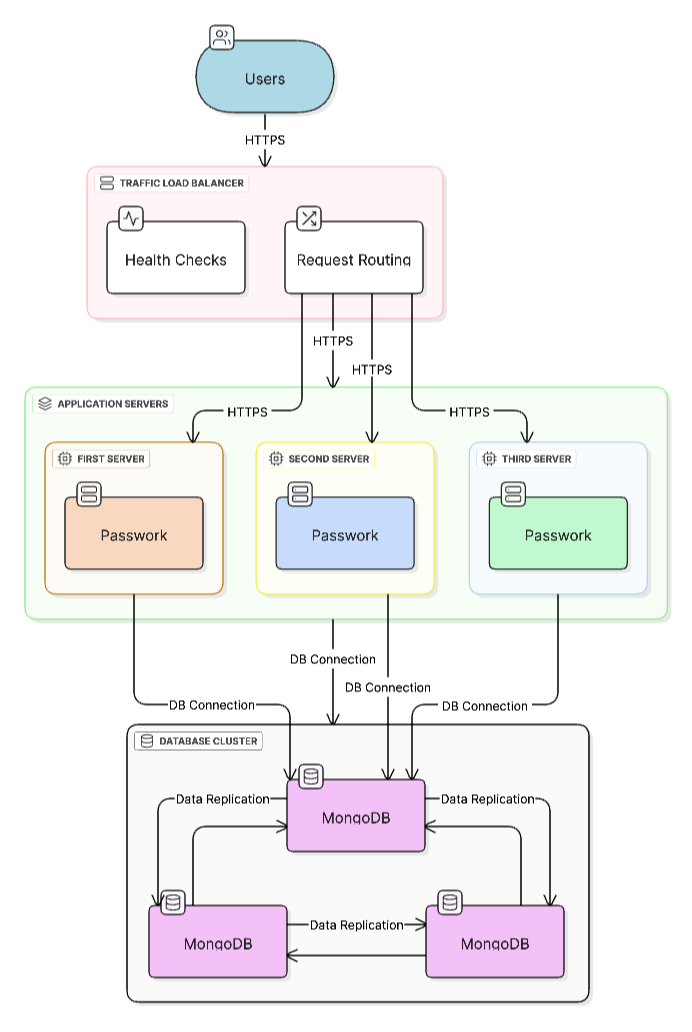
- Redundant application servers — several application servers run in parallel, so the service stays available even if one or more nodes fail.
- Database replication — a MongoDB replica set keeps data synchronized across nodes and elects a new Primary automatically.
Minimum requirements:
- At least 2 application servers behind a load balancer
- At least 3 MongoDB nodes in a replica set
- Independent infrastructure for database nodes (separate racks/data centers when possible)
- Configured health checks and connection monitoring
General architecture of a fault-tolerant system:
Scalability
Passwork supports two scaling models to increase performance and handle more users.
Horizontal scaling
Horizontal scaling (scale-out) means adding new servers to the pool to spread the load.
Advantages:
- Higher throughput by distributing requests across servers
- High availability — if one server fails, others keep working
- Gradual, incremental expansion
Use cases:
- Adding new Passwork application servers
- Expanding the MongoDB replica set with additional secondary nodes
Vertical scaling
Vertical scaling (scale-up) means increasing resources (RAM, CPU, storage) on an existing server.
Advantages:
- Quick performance boost without changing the architecture
- Simple to implement — no balancing or synchronization required
- Suitable for small and mid-size loads
Limitations:
- Hardware limits (max RAM/CPU on a single host)
- Single point of failure — if the server goes down, the system is unavailable
- A powerful single server can cost more than several smaller ones
Recommendations
- For fault-tolerant deployments, prefer horizontal scaling
- Vertical scaling fits early-stage setups or environments without strict HA requirements
- A combined approach also works: scale servers up when needed and scale out for availability
Components of the fault-tolerant architecture
A fault-tolerant Passwork deployment consists of two main components.
1. Multiple application servers
Using several Passwork application servers behind a load balancer provides:
- Automatic traffic redistribution if a server fails
- Even load distribution across healthy servers
- Horizontal scalability
Learn more about architecture, load balancing, and health checks in application servers.
2. Database replication
Using a MongoDB replica set provides:
- Automatic elections and Primary replacement when the current Primary fails
- Data synchronization between nodes
- High data availability
More details are in database.
Benefits of a fault-tolerant architecture
High availability
The system keeps running even when individual components fail:
- If an application server goes down, the load balancer routes traffic to the remaining servers
- If the Primary database node fails, the replica set elects a new Primary, and application servers start using it
Scalability
A fault-tolerant architecture makes it easy to scale:
- Horizontal scaling — add application servers and MongoDB nodes
- Vertical scaling — add resources to existing servers
Performance
Distributing load across multiple servers allows you to:
- Serve more concurrent requests
- Reduce pressure on each server
- Improve response times